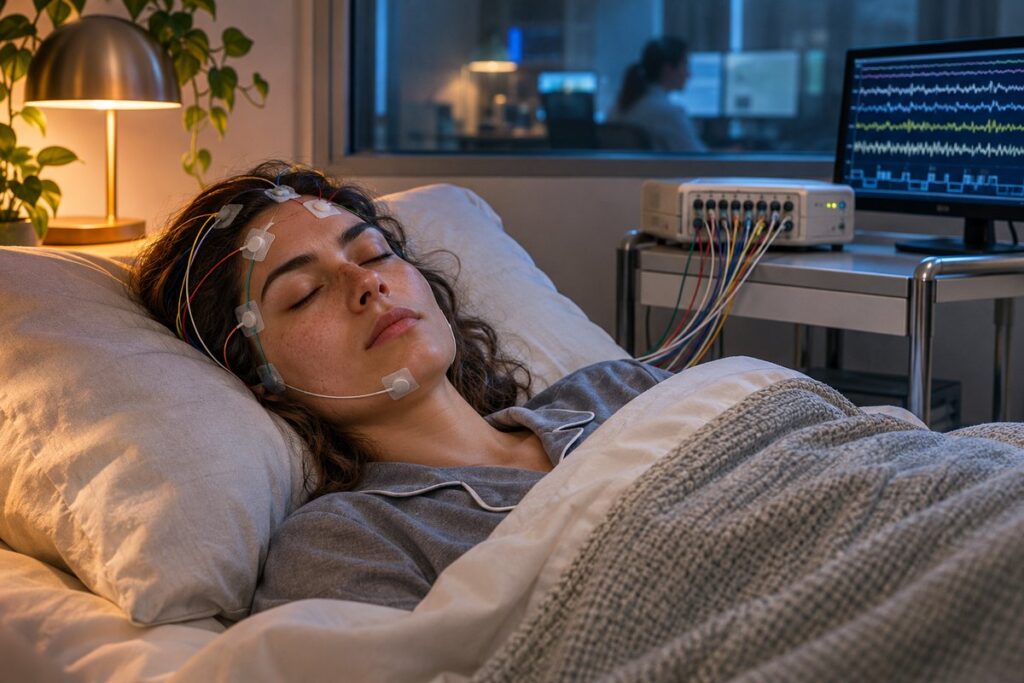
In the morning a sleeper can tell you that the night seemed to go by in an instant. On a laboratory recording, that same night may contain several awakenings and a long interval before the first episode of rapid eye movement sleep. Both accounts belong to the same person. One records what it was like to spend a night in bed. The other reconstructs the night from signals the sleeper could hardly be expected to remember.
Reading a night from left to right
Researchers studying cannabis and sleep often use polysomnography, the formal name for an overnight sleep study. Electrodes record patterns of brain activity, and sensors track eye movements and muscle activity. A typical clinical recording can also include breathing, blood oxygen and heart rate, as the National Heart, Lung, and Blood Institute explains. Together these signals let a scorer identify periods of wakefulness, stages of non-REM sleep and REM sleep.
Draw the stages across a page in time order and you get a hypnogram. The first transition into sleep supplies one number, the time it took to fall asleep. Adding the segments scored as sleep gives another, total sleep time. Minutes spent awake after sleep began tell a third story. An intervention might shorten the wait at the start and leave someone awake for longer later on. A single judgment that bedtime “went well” might chiefly reflect those first few minutes.
Even percentages need a denominator. Two nights can include the same number of minutes in REM yet show different REM percentages if total sleep time changes. Conversely, a longer night may contain more minutes in a stage even when its share is unchanged. A published claim about “less REM” becomes much easier to interpret once the reader knows which quantity the investigators compared.
What the studies agree on
A 2025 systematic review of cannabis and sleep architecture identified 18 polysomnography studies, nine suitable for quantitative pooling. Across studies, cannabis administration produced no consistent change in sleep duration, time to fall asleep, wake time, efficiency or sleep staging. Some early, small studies using substantial THC doses reported less REM sleep. Later studies produced mixed findings. A single, recognizable “cannabis night” did not emerge from the recordings.
There were several opportunities for differences to arise. Participants varied in their prior experience with cannabis and in their health. The preparations and doses varied, too. And a night following administration answers a different question from a night after someone accustomed to regular use stops. The review found more consistent signs of sleep disruption during withdrawal. One study that recorded several nights of abstinence specifically enrolled people who had experienced sleep trouble on previous attempts to stop. Combining both sorts of nights in one description would erase the distinction between taking a substance and adapting to its absence.
A week on the wrist
A cohort study of middle-aged adults took the observation home. Participants wore activity monitors for a week. Recent cannabis use was associated with longer sleep duration and poorer objective sleep quality, while the researchers found no corresponding association with subjective sleep. Wrist activity can estimate patterns of sleep and wake across ordinary nights. It does not supply the electrical signals used to distinguish sleep stages in polysomnography.
Participants in that cohort were living their own lives, and nobody randomly assigned their histories of cannabis use. An association across participants therefore cannot specify what would happen to one person’s sleep after taking cannabis on one particular evening. What it does establish is how easily duration, continuity and a person’s own verdict can travel in different directions.
The sleeper’s morning account still belongs in the record. Feeling rested, remembering repeated interruptions or dreading another long wait for sleep are experiences that a stage diagram cannot report. The diagram earns its place alongside the account by showing where in the night to look when those experiences fail to match a simple count of hours.