A plant compound can have an effect on the brain without having any natural business there. So the discovery that THC acts at a receptor raised a particularly intriguing question. What, under ordinary circumstances, was the receptor responding to? In 1992 a team working with brain tissue identified a candidate that the body itself could supply. They named it anandamide.
Looking for an occupant by following its seat
A receptor is a molecule that can bind certain other molecules and help a cell respond. Discovering a receptor does not instantly identify every substance that acts there. The useful experimental trick is competition. If a known compound binds to a preparation containing the receptor, a second compound may displace it. A decrease in binding can become a clue that an unidentified substance has interacted with the system.
In the original paper reporting anandamide, investigators isolated a constituent from pig brain and established its structure. The source was part of the scientific surprise. Scientists had begun with the pharmacology of a plant and ended with a lipid found in animal tissue. The substance was named after a Sanskrit word associated with bliss. That memorable name describes neither a measurement made in the experiment nor a promise about what the molecule makes a person feel.
How to follow something you cannot yet name
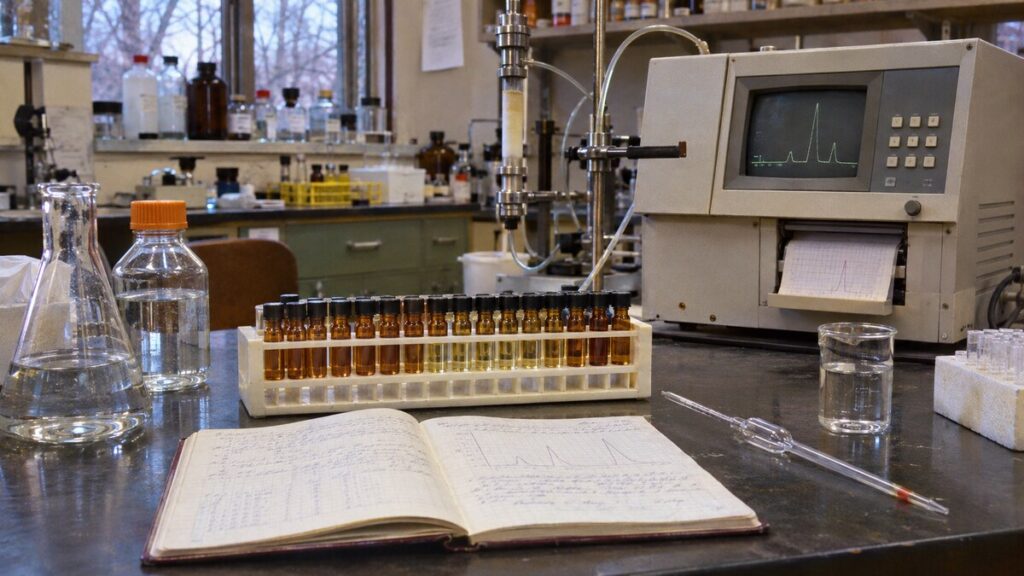
Imagine separating a complex extract into several portions and finding that only one portion changes a binding measurement. The investigator can separate that portion further and ask which of the smaller fractions retains activity. Repeating this process gives the search a direction without requiring a complete inventory of everything in the original tissue. It also creates opportunities for error. A fraction may contain a mixture, and an apparent signal may weaken as a fragile constituent is lost.
Structural analysis supplies another kind of test. If researchers can establish a candidate structure and compare the isolated substance with a compound of known identity, the match is stronger than an activity measurement alone. Conversely, a perfect structural description does not show where or when a living brain uses the molecule. Chemical identification and physiological function are different chapters in the investigation.
A family emerged from a single discovery
The term endocannabinoid refers to signaling molecules made within the body that act on cannabinoid receptors. In 1995 researchers reported 2-arachidonoylglycerol, another candidate ligand in brain. Anandamide is one member of a broader system that includes other signaling molecules, receptors and enzymes involved in their formation and breakdown. A review of cannabinoid receptors and their endogenous ligands traces how evidence accumulated for this larger family. The plant was a starting point for discovery, not an ingredient the body needs in order to use the system.
An analogy with an ordinary key helps only up to a point. It captures the idea that more than one molecule may bind in a particular place. It leaves out how long the molecule stays, how strongly it affects signaling and which cells have the relevant receptors. Two substances that interact with the same receptor can have different distributions and time courses throughout the body. Sharing a target does not make them interchangeable.
From a test tube to a conversation between neurons
Later work connected endocannabinoids to signaling at the junctions between neurons. In certain circuits a receiving cell can generate a signal that travels back toward the cell supplying its input. Research on retrograde endocannabinoid signaling describes how that feedback can alter the release of conventional neurotransmitters. It took experiments quite different from a binding assay to establish the direction and timing of the message.
That is what makes the original question such a good piece of scientific history. Finding anandamide answered what could occupy a receptor when no cannabis was present. It also opened a much larger question that could no longer be answered by studying cannabis alone. What were cells saying to each other all along, before anybody thought to listen at that receptor?