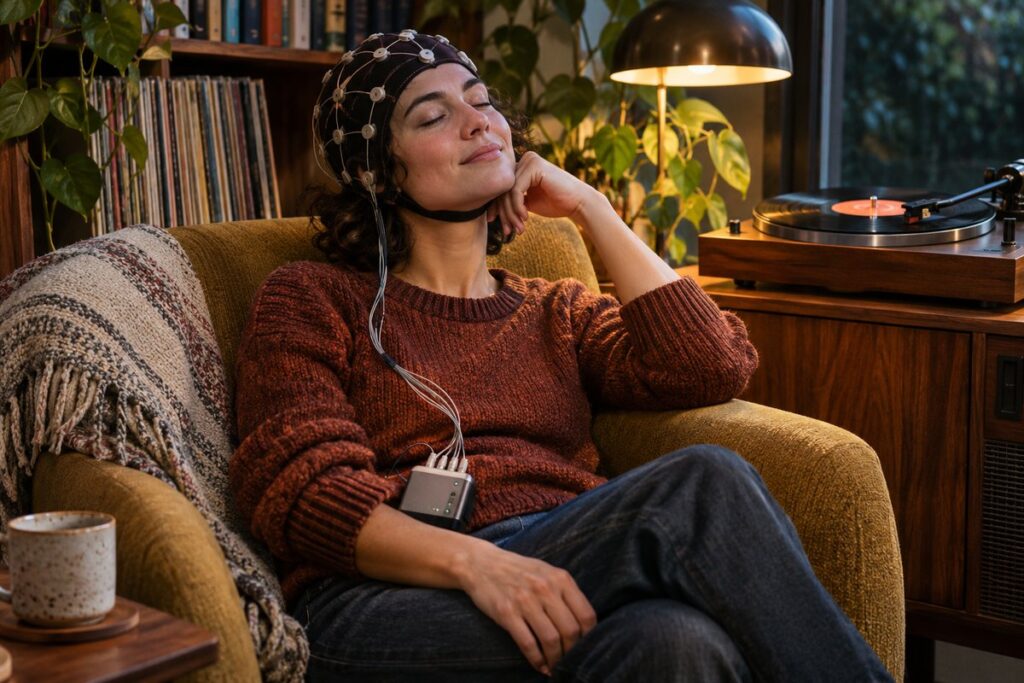
A listener says the bass line has suddenly come forward in a recording she knows by heart. The speakers are in the same place. The engineer has not remixed the song. What changed? A musician might ask what the listener was following a moment earlier. A neuroscientist might look for a change in attention. In a small study of cannabis and music, Jörg Fachner tried to keep both questions alive by taking a brain recording into a setting familiar to the people doing the listening.
Taking the instrument to the listener
Fachner’s ethnographic study in Anthropology of Consciousness combined descriptions of the listening experience with a mobile electroencephalography system, or EEG. The investigation followed four individual cases and included observations before and after cannabis use. This was an unusual bargain. Bringing the equipment into familiar surroundings preserved some of the circumstances in which people ordinarily listened. In return, the researcher gave up some of the control that makes laboratory comparisons relatively straightforward.
In a familiar room, knowing a piece of music can be part of the phenomenon under investigation. A listener who expects a bass entrance can notice that it feels especially prominent. In a laboratory experiment, differences in familiarity between participants might instead be something the researchers try to control. Researchers who sample everyday music choices ask people what they are doing as they listen. A track chosen for a purpose brings part of that purpose into the experiment. Familiarity might help explain a listening experience or complicate a comparison between strangers.
What travels through the electrodes
Scalp electrodes measure small changes in electrical potential. Researchers can break the signal down into frequency ranges and study where the strength of a rhythm changes over time. Fachner described changes in alpha and theta activity and explored an interpretation involving altered attention to acoustic space. The physical observation and its interpretation have different levels of certainty. A change in an electrical rhythm does not identify which instrument a person has started to follow.
Everyday listening also involves movement. A blink, a tightened jaw or a shift of the head can contribute electrical activity to the recording. As an Oxford primer on EEG artifacts explains, some signals with no origin in the brain can be appreciable at scalp electrodes. An expressive listener might move most during exactly the passage the investigator hopes to understand. Separating movement from a response to the music is part of the measurement itself.
The limits of playing something twice
Comparing a person with their own earlier listening session removes some obvious differences between people. The same person brings the same ears and much of the same musical history. Yet a second encounter is a second encounter. A listener may remember a detail from the first hearing, grow more comfortable in the equipment or expect the music to sound different after cannabis. A before-and-after comparison alone cannot assign a share of the change to each of those influences.
Inside the scanner, a different comparison
A later experiment with 16 cannabis users used three sessions involving cannabis with CBD, cannabis without CBD and placebo. In a functional MRI scanner, participants heard music and scrambled sounds. Compared with placebo, the preparation without CBD dampened responses to music in several regions, including parts of the auditory cortex. The investigators had specified which comparison would count as a response to music, and they had a placebo condition against which to measure it.
That finding does not settle whether Fachner’s listeners genuinely heard familiar passages differently. Their accounts concerned a particular encounter with a piece of music, while the scanner experiment measured a difference between responses under controlled conditions. A stronger sense of involvement and a smaller response on a specified brain measure can coexist.
The most informative detail in a listener’s account may be unfashionably specific: which instrument came forward, during which passage, on which hearing. Those particulars give a future experiment something precise to test. And they keep an electrical trace, however attractive on the page, from being mistaken for a report of what the song sounded like.